
Start with this real reader: The Cat and the Rat
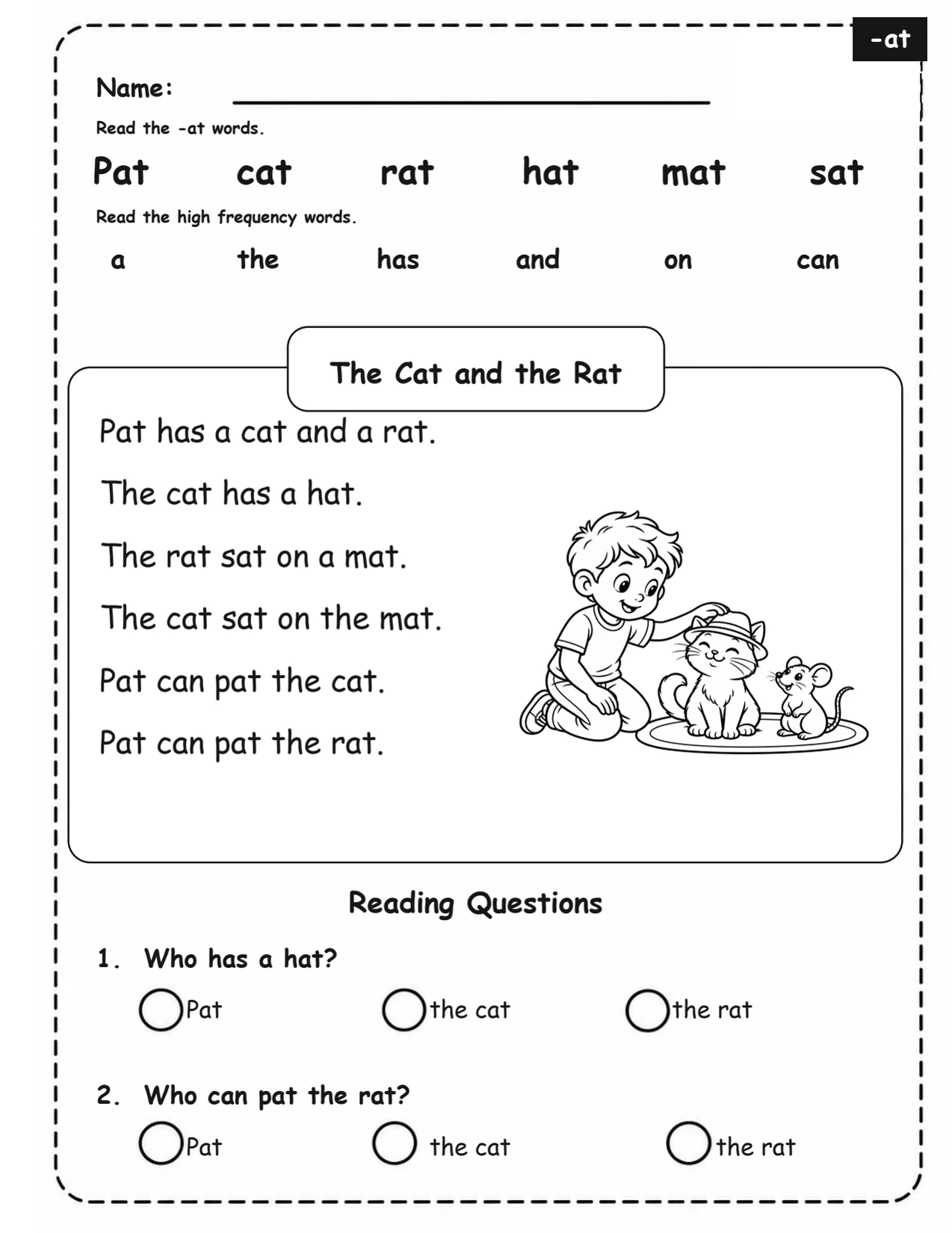
This example uses Book 1 Reader 01 from BeMoFun Decodable Readers. It practices the -at family in a short passage about Pat, a cat, and a rat. The sample below is the existing product preview; preparation and answer evidence follow the matching Book 1 teacher guide and answer key.
Use the page after teaching the relevant sounds and CVC blending, with support for unfamiliar words. Print on US Letter paper at Actual Size / 100%. In the included Book 1 Student Workbook, the cover is PDF page 1 and this first reader is PDF page 2.
1. Prepare the two word rows
Read the top row: Pat, cat, rat, hat, mat, sat. Model the taught sounds in one word, blend it, and invite the child to try another. Point out that Pat is the character’s name; pat also appears later as an action word.
Next, read a, the, has, and, on, can. Check which words the child already knows and teach any unfamiliar spelling parts. For example, if the pronunciation of has is unfamiliar, model it before the passage. The two rows are a warm-up, so also scan the complete text for anything else the child needs you to explain.
2. Read a sentence, then return to its meaning
Begin with “Pat has a cat and a rat.” Ask the child to follow the print and read. If they say rat for cat, point to the first letter and help them use the taught sounds to blend cat. Then read the complete sentence again so the corrected word stays connected to the idea.
After “The rat sat on a mat,” you might ask, “Who sat on the mat in this sentence?” Use the printed sentence to resolve cat versus rat. The illustration supports discussion, but the words tell the child what to read.
3. Answer both questions with the passage nearby
Read the question aloud if its wording has not been taught. Give the child time to look back at the passage before choosing an answer. The choices run left to right as A, B, and C in the answer key.
| Question on the worksheet | Correct choice | Words to find in the passage |
|---|---|---|
| Who has a hat? | B — the cat | The cat has a hat. |
| Who can pat the rat? | A — Pat | Pat can pat the rat. |
- For Question 1, ask the child to find the sentence about the hat and point to who has it.
- For Question 2, return to the final sentence and ask the child to show who does the action.
- After a mistaken choice, reread the evidence together and invite the child to choose again.
4. Choose one useful rereading task
Choose the next task from what you heard. If cat and rat were confused, revisit those words and their sentences. If the words were read accurately but the child forgot who had the hat, reread that sentence and ask them to explain it. Select the rereading task that serves this learner.
For this page, your note might say, “Reread cat and rat; check the initial sound; then find the hat sentence.” Acknowledge the child checking a word or finding evidence. Choose the next reader according to the skills already taught.
Take the same routine to the next suitable page
In a guided group, prepare the words together and listen to individual readers before discussing the questions. For home practice, give the adult the selected page, the words to preview, and the two evidence sentences to check. Keep the child’s copy available during the conversation.
The collection contains 256 one-page readers with two questions each, plus a teacher guide and evidence-based answer key for every book. These are supplemental practice materials. Check the guide for the next page: a familiar layout can still contain unfamiliar spellings.