Choose the pattern first, then check the whole passage
Start with a phonics pattern you have already taught. Find a passage that gives the child practice with that pattern, then read it yourself to check the other spellings, support words, and vocabulary. A familiar target pattern is useful only if the rest of the page is manageable too.
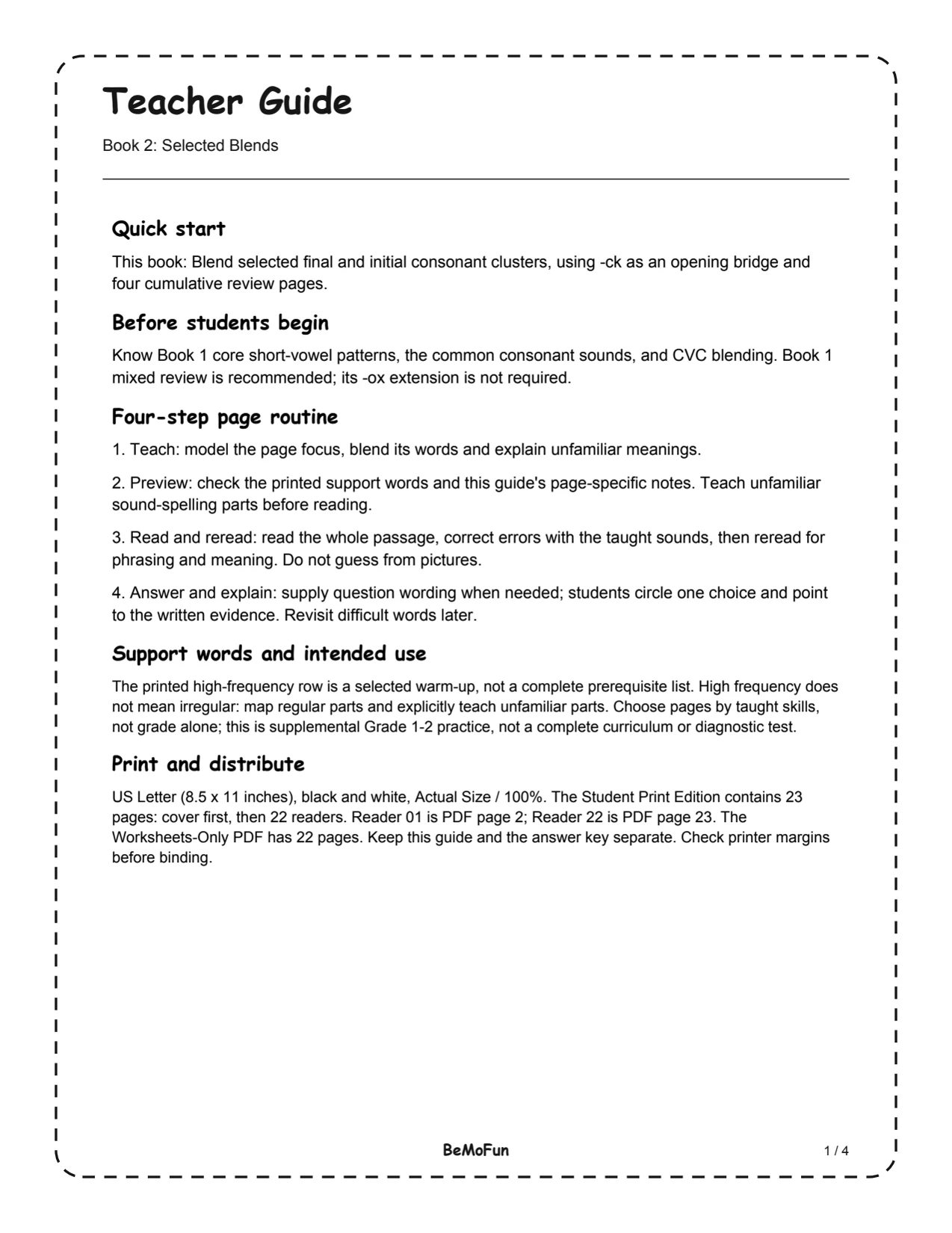
In BeMoFun, the book outline narrows your search; the matching teacher guide helps you check the individual page. The collection has 11 books and 256 one-page readers. It is supplemental practice for skills already taught, rather than a complete phonics curriculum or a placement test.
Find a possible book with this skill map
Read the middle column as a practice focus. Later books draw on earlier patterns and supported words. Check the page-specific notes when selecting a page out of sequence; optional extensions in earlier books do not automatically become prerequisites.
| Book | Practice focus | Check before the selected page |
|---|---|---|
| 01 · Short Vowels | Short-vowel families, then mixed review. | Common consonant sounds, CVC blending, and the printed support words. |
| 02 · Selected Blends | -ck, selected final blends, and beginning L-, R-, and S-blends. | Book 1 core short vowels and CVC blending. The Book 1 -ox extension is not required. |
| 03 · Double Endings & Digraphs | -ll, -ss, -ff, sh, ch, and th. | Short vowels, selected blends, and blending words with initial or final consonant clusters. |
| 04 · Long Vowels: Silent e | a_e, i_e, o_e, selected u_e, and short-vowel comparisons. | Core patterns from Books 1–3. Teach the selected silent-e pattern before its passage. |
| 05 · Word Endings & Longer Words | -s/-es, -ed, -ing, compounds, and selected syllables. | Core patterns from Books 1–4 and the actual words used. Optional e_e is not required. |
| 06 · Advanced Ending Patterns | tch, dge, selected word groups, final y, and consonant-le. | Earlier inflections and selected open/closed syllables; teach new word-specific patterns. |
| 07 · R-Controlled Vowels | ar, or/ore, er, ir, ur, and selected longer words. | Earlier core patterns and supported words; model the vowel sound in the learner’s local U.S. accent. |
| 08 · Long Vowel Teams | ai/ay, ee, selected ea/ey, oa/ow/oe, igh, and ie. | Earlier core patterns, controlled longer words, and inflections. |
| 09 · Other Vowel Teams & Diphthongs | Two oo sounds, selected ew/ue/ui, aw/au, oi/oy, and ou/ow. | Earlier core patterns; explicitly model the pronunciation for the selected group. |
| 10 · Alternative & Silent Spellings | ph, kn/wr/mb, soft c/g, and selected alternative spellings. | Earlier core spellings and supported words; preview the exact spelling and vocabulary. |
| 11 · Word Building & Cumulative Reading | Spelling changes, prefixes, suffixes, and cumulative text. | Earlier core patterns and familiar base words; teach the selected spelling change or affix. |
Three examples of a teaching decision
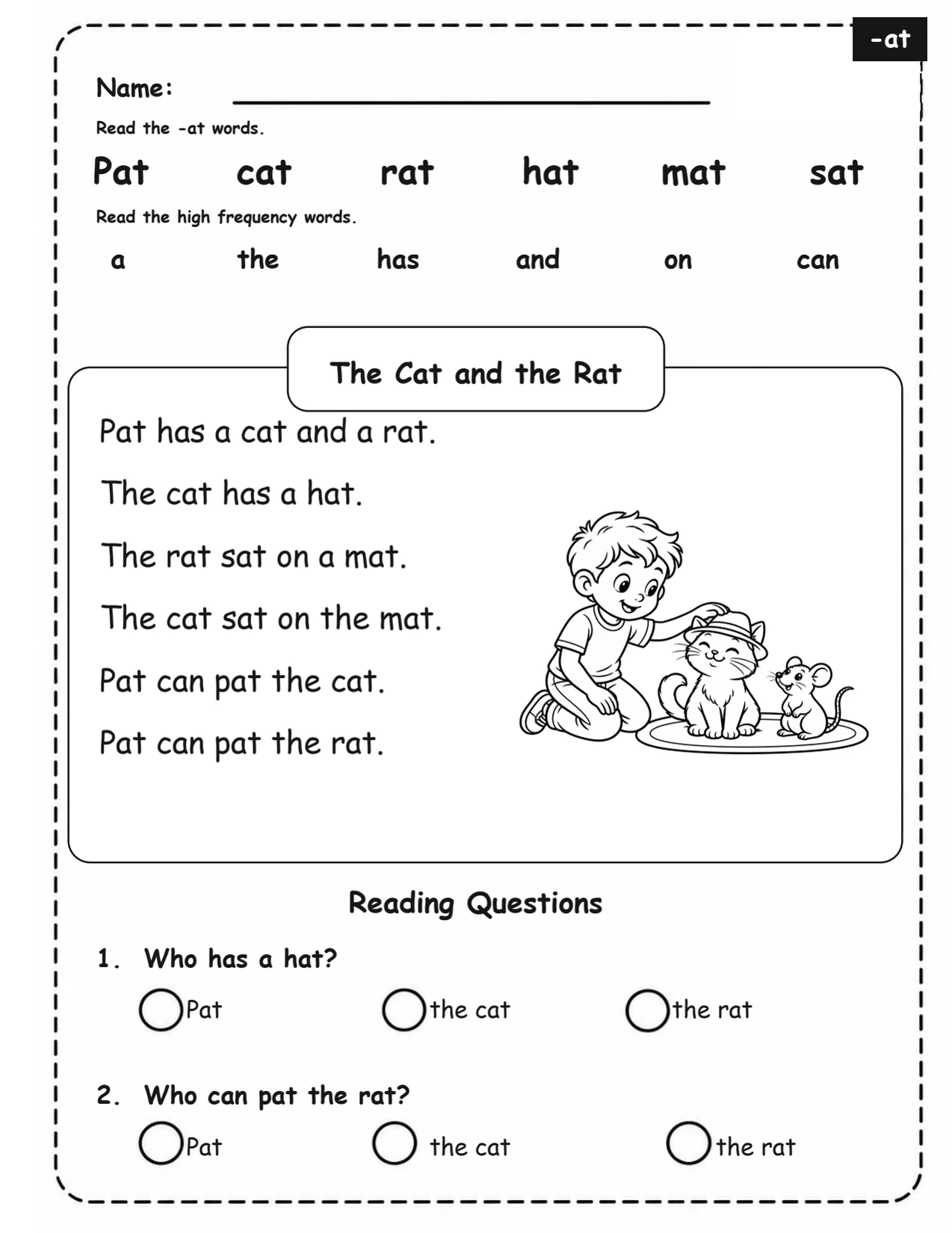
If a child can blend short-a CVC words and you have taught the -at family, consider Book 1 Reader 01, “The Cat and the Rat.” Its warm-up includes Pat, cat, rat, hat, mat, and sat. Check the support row—a, the, has, and, on, can—and any other unfamiliar words before using it.
If short-vowel CVC reading is familiar and you have taught -ck, consider Book 2 Reader 01, “Jack and the Duck.” Check the guide’s preparation notes for that page as well as the passage. Select the other blends in Book 2 as their patterns are taught.
If the child has the earlier core patterns and you have taught a_e, Book 4’s a_e pages may fit. A child who reads cat and mat but has not learned silent e still needs instruction before reading cake-type words. The teacher guide identifies the preparation; the grade label alone cannot make that decision.
Use the first page to decide what support comes next
Listen as the child reads a few warm-up words and begins the passage. Notice the kind of difficulty: are they unsure of the target spelling, stuck on a support word, or reading the words without following the meaning? Each calls for a different response.
| What you notice | Try next |
|---|---|
| The target spelling is unfamiliar. | Return to explicit teaching of that spelling, then use a matching passage for practice. |
| Target words are manageable, but a support word is unfamiliar. | Teach that word’s unfamiliar spelling or meaning and reread the sentence. |
| Several earlier patterns need teaching. | Choose a page with more familiar prerequisites. |
| The words are read, but the event is unclear. | Reread a short section and discuss what happened before moving to the questions. |
Keep a small preparation note with the page
A note can be as short as: “Book 1 Reader 01; practice -at; preview the and has; listen for cat versus rat; ask the child to point to the sentence that answers each question.” Adjust it to what this learner actually needs.
For home practice, send the selected page after teaching the relevant skills and explain those same preparation points to the adult. Use the companion article on one-page reading worksheets for a complete worked example with this reader.