
Keep decoding connected to meaning
Word lists are useful for spotting vowel patterns, but students also need to use those words in connected text. A simple sentence provides enough context for students to check whether their decoding makes sense.
Preview the picture without giving away every word. Invite students to predict which short-vowel words might appear, then confirm those predictions while reading.
Plan a short lesson cycle
Start with two minutes of oral blending, move into a sentence-building task, and finish with rereading. This keeps phonics, comprehension, and writing in the same lesson instead of treating them as unrelated skills.
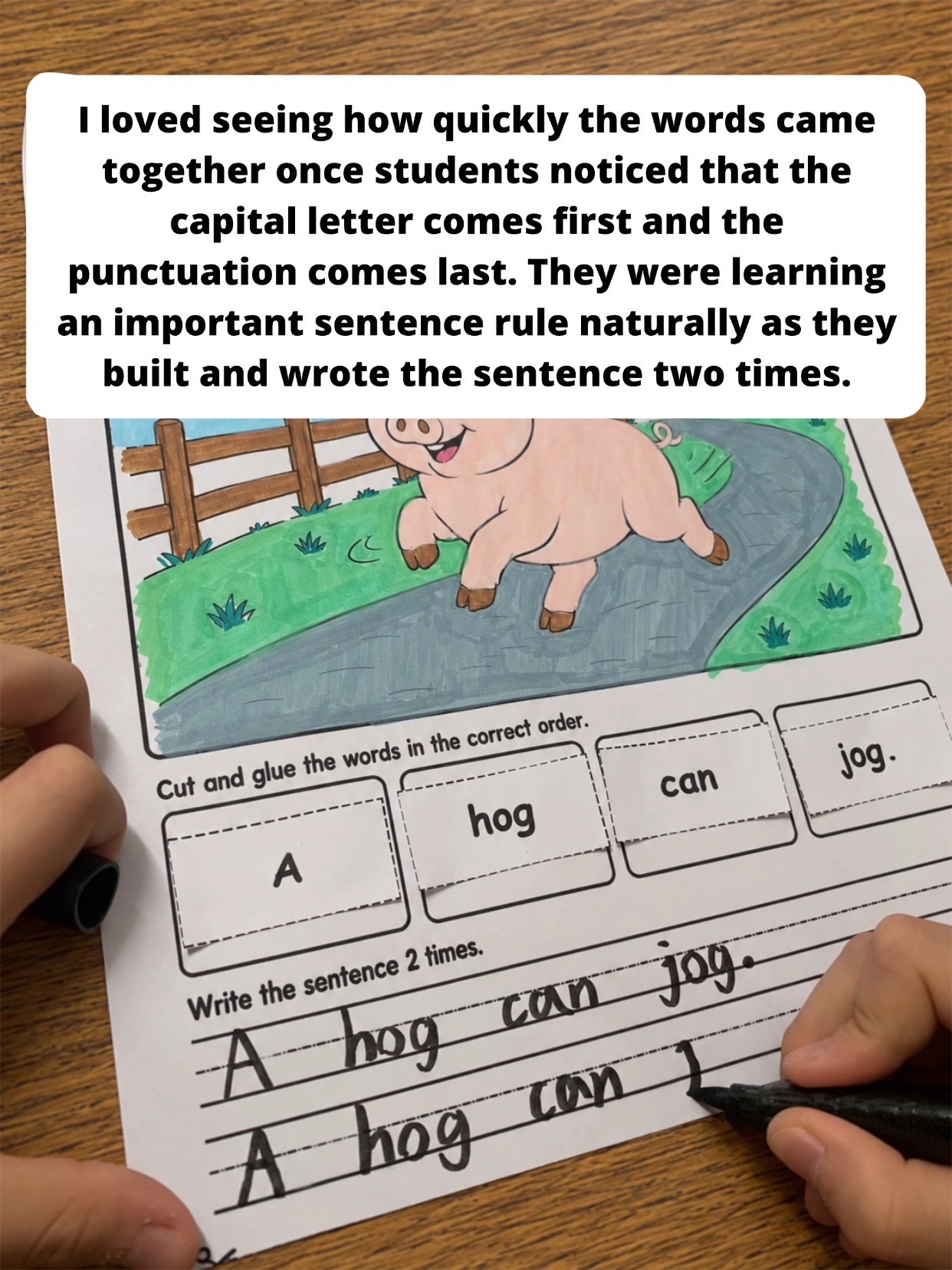
- Blend two or three target words.
- Build and read one sentence.
- Write the sentence with spaces and punctuation.
- Reread for accuracy and meaning.
Use errors to choose the next prompt
If a student reads the words correctly but scrambles the sentence, focus on syntax and oral rehearsal. If the order is correct but decoding is slow, reduce the number of new CVC words.
The goal is not speed alone. A successful reader can decode, preserve word order, and explain what the sentence means.